Indigenous Territorialities in the university
DOI:
https://doi.org/10.62009/bemviver.2764.9679n2/2025/491/p54-56Keywords:
territorialidade, formação ind´ígena, universidadeAbstract
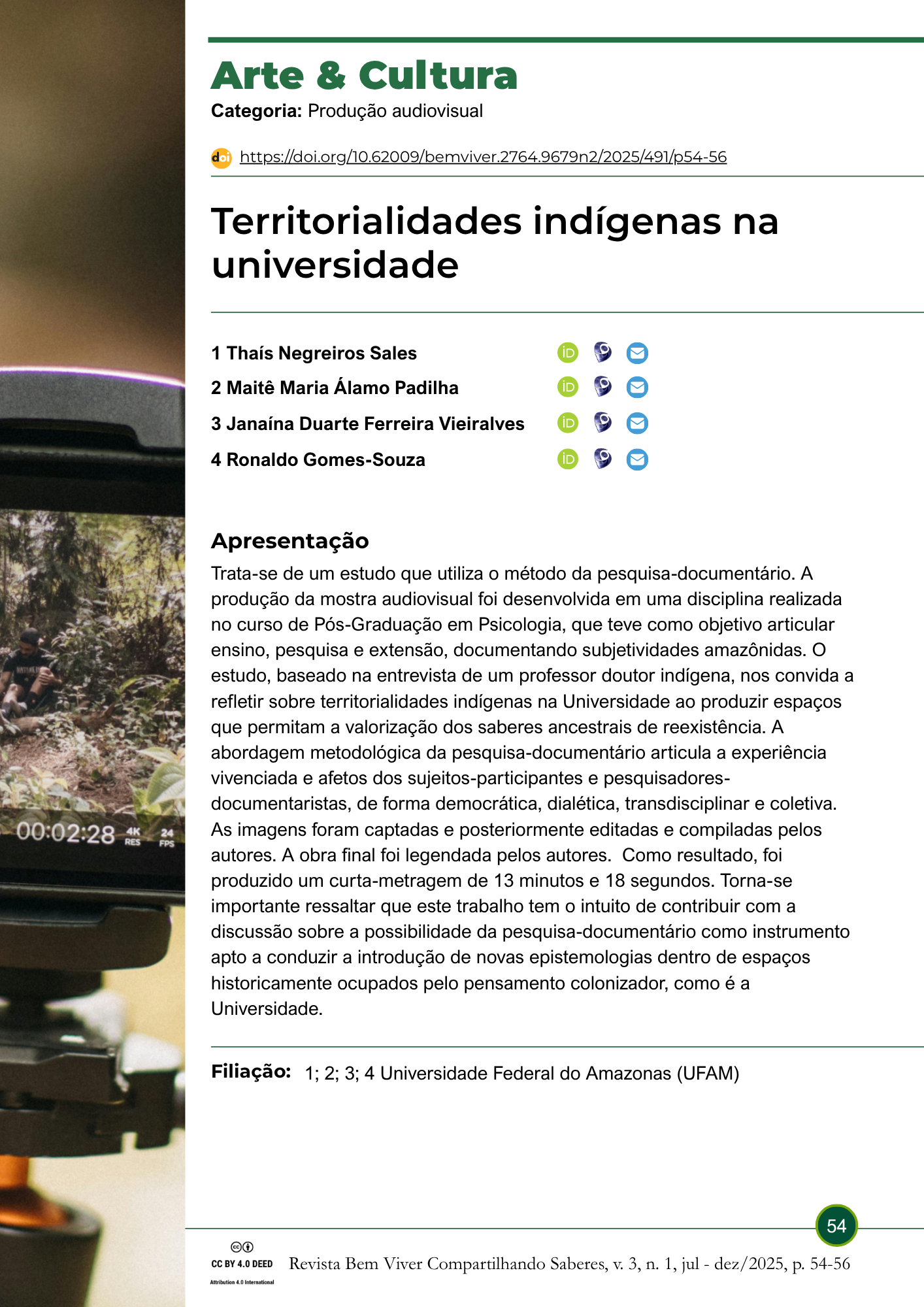
This study uses the research-documentary method. The production of the audiovisual exhibition was developed within a course offered in a Graduate Program in Psychology, aiming to articulate teaching, research, and extension activities through the documentation of Amazonian subjectivities. Based on an interview with an Indigenous professor holding a doctoral degree, the study invites us to reflect on Indigenous territorialities within the university by producing spaces that enable the recognition and appreciation of ancestral knowledges of re-existence. The methodological approach of research-documentary articulates the lived experience and affects of the subject-participants and researcher-documentarists in a democratic, dialectical, transdisciplinary, and collective manner. The images were captured and later edited and compiled by the authors. The final work was subtitled by the authors. As a result, a short film of 13 minutes and 18 seconds was produced. It is important to emphasize that this work seeks to contribute to the discussion on the possibility of research-documentary as an instrument capable of introducing new epistemologies into spaces historically occupied by colonizing thought, such as the university.
Downloads
Metrics
Downloads
Published
How to Cite
Conference Proceedings Volume
Section
Categories
License
Copyright (c) 2026 Thaís Negreiros Sales, Maitê Maria Álamo Padilha, Janaína Duarte Ferreira Vieiralves, Ronaldo Gomes-Souza

This work is licensed under a Creative Commons Attribution 4.0 International License.
The articles, images, and works published in the journal Bem Viver Compartilhando Saberes are under the Creative Commons Attribution 4.0 International License, ensuring Open Access. In this way, the authors retain the copyright to their works and, in the event of republication, are requested to indicate the first publication in this journal. This license allows anyone to read, download, copy, and share the content, provided proper citation is given. It also authorizes redistribution, adaptation, and the creation of derivative works in any format or medium, including commercial use, as long as attribution to the journal is maintained.
The journal reserves the right to make normative, orthographic, and grammatical changes to the originals, in order to maintain the formal standard of the language and the credibility of the publication. It will, however, respect the authors’ writing style. Conceptual changes, corrections, or suggestions will be sent to the authors when necessary.
The opinions expressed by the authors of the articles are their sole responsibility.
Source: Educação em Análise.