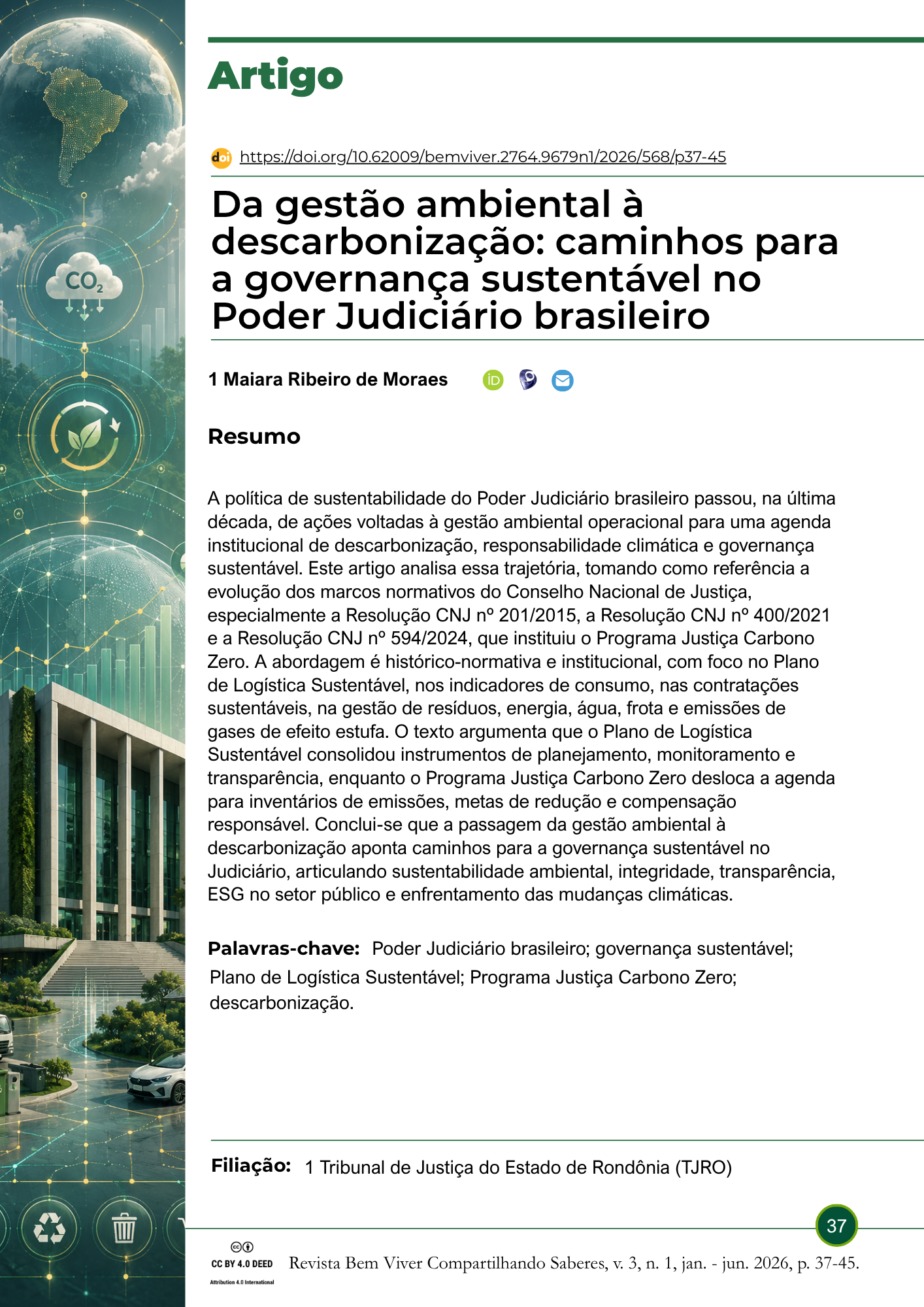
From environmental management to decarbonization: pathways toward sustainable governance in the Brazilian Judiciary
DOI:
https://doi.org/10.62009/bemviver.2764.9679n1/2026/568/p37-45Keywords:
Brazilian Judiciary, sustainable governance, Sustainable Logistics Plan, Justiça Carbono Zero program, decarbonizationAbstract
Over the past decade, the sustainability policy of the Brazilian Judiciary has moved from actions focused on operational environmental management to an institutional agenda of decarbonization, climate responsibility, and sustainable governance. This article analyzes that trajectory by examining the development of the regulatory frameworks issued by the National Council of Justice, especially Resolution CNJ no. 201/2015, Resolution CNJ no. 400/2021, and Resolution CNJ no. 594/2024, which established the Justiça Carbono Zero program. The approach is historical-normative and institutional, focusing on the Sustainable Logistics Plan, consumption indicators, sustainable public procurement, waste management, energy, water, vehicle fleets, and greenhouse gas emissions. The article argues that the Sustainable Logistics Plan consolidated tools for planning, monitoring, and transparency, while the Justiça Carbono Zero program shifts the agenda toward emissions inventories, reduction targets, and responsible offsetting. It concludes that the transition from environmental management to decarbonization points to pathways for sustainable governance in the Judiciary, connecting environmental sustainability, integrity, transparency, ESG in the public sector, and climate change mitigation.
Downloads
Metrics
References
BRASIL. Decreto nº 7.746, de 5 de junho de 2012. Regulamenta o art. 3º da Lei nº 8.666, de 21 de junho de 1993, para estabelecer critérios, práticas e diretrizes para a promoção do desenvolvimento nacional sustentável nas contratações realizadas pela administração pública federal. Diário Oficial da União: Brasília, DF, 6 jun. 2012. Disponível em: https://www.planalto.gov.br/ccivil_03/_ato2011-2014/2012/decreto/d7746.htm. Acesso em: 2 jul. 2026.
CONSELHO NACIONAL DE JUSTIÇA. Resolução nº 201, de 3 de março de 2015. Dispõe sobre a criação e competências das unidades ou núcleos socioambientais nos órgãos e conselhos do Poder Judiciário e implantação do respectivo Plano de Logística Sustentável. Brasília, DF: CNJ, 2015. Disponível em: https://atos.cnj.jus.br/atos/detalhar/2126. Acesso em: 2 jul. 2026.
CONSELHO NACIONAL DE JUSTIÇA. Resolução nº 400, de 16 de junho de 2021. Dispõe sobre a política de sustentabilidade no âmbito do Poder Judiciário. Brasília, DF: CNJ, 2021. Disponível em: https://atos.cnj.jus.br/atos/detalhar/3986. Acesso em: 2 jul. 2026.
CONSELHO NACIONAL DE JUSTIÇA. Resolução nº 594, de 8 de novembro de 2024. Institui o Programa Justiça Carbono Zero e altera a Resolução CNJ nº 400/2021. Brasília, DF: CNJ, 2024. Disponível em: https://atos.cnj.jus.br/atos/detalhar/5845. Acesso em: 2 jul. 2026.
CONSELHO NACIONAL DE JUSTIÇA. Resolução nº 641, de 22 de setembro de 2025. Altera a Resolução nº 400/2021, que dispõe sobre a política de sustentabilidade no âmbito do Poder Judiciário, para adequá-la à Lei nº 14.133/2021, e incentivar práticas de inovação. Brasília, DF: CNJ, 2025. Disponível em: https://atos.cnj.jus.br/atos/detalhar/6320. Acesso em: 2 jul. 2026.
MINISTÉRIO DO MEIO AMBIENTE E MUDANÇA DO CLIMA. A3P: Agenda Ambiental na Administração Pública. Brasília, DF: MMA, [s.d.]. Disponível em: http://a3p.mma.gov.br/. Acesso em: 2 jul. 2026.
ORGANIZAÇÃO DAS NAÇÕES UNIDAS. Transformando nosso mundo: a Agenda 2030 para o desenvolvimento sustentável. Nova York: ONU, 2015a. Disponível em: https://brasil.un.org/sites/default/files/2020-09/agenda2030-pt-br.pdf. Acesso em: 2 jul. 2026.
ORGANIZAÇÃO DAS NAÇÕES UNIDAS. Acordo de Paris. Paris: ONU, 2015b. Disponível em: https://brasil.un.org/sites/default/files/2020-08/Acordo-de-Paris.pdf. Acesso em: 2 jul. 2026.
VOLTOLINI, Ricardo. Vamos falar de ESG? Provocações de um pioneiro em sustentabilidade empresarial. Osasco:Editora Voo, 2021.
Published
How to Cite
Conference Proceedings Volume
Section
Categories
License
Copyright (c) 2026 Maiara Ribeiro de Moraes

This work is licensed under a Creative Commons Attribution 4.0 International License.
The articles, images, and works published in the journal Bem Viver Compartilhando Saberes are under the Creative Commons Attribution 4.0 International License, ensuring Open Access. In this way, the authors retain the copyright to their works and, in the event of republication, are requested to indicate the first publication in this journal. This license allows anyone to read, download, copy, and share the content, provided proper citation is given. It also authorizes redistribution, adaptation, and the creation of derivative works in any format or medium, including commercial use, as long as attribution to the journal is maintained.
The journal reserves the right to make normative, orthographic, and grammatical changes to the originals, in order to maintain the formal standard of the language and the credibility of the publication. It will, however, respect the authors’ writing style. Conceptual changes, corrections, or suggestions will be sent to the authors when necessary.
The opinions expressed by the authors of the articles are their sole responsibility.
Source: Educação em Análise.